PG — Prime Guardian: a software layer for drone security.
PG — Prime Guardian is a concept platform for detecting, tracking and safely neutralizing unauthorized drones, plus escorting protected people, vehicles or sites. It is being developed toward real-hardware integration, controlled validation and commercial readiness. Real-world performance and deployment remain subject to authorized testing and regulatory approval.
100% autonomous decision loop — Ground Control monitors only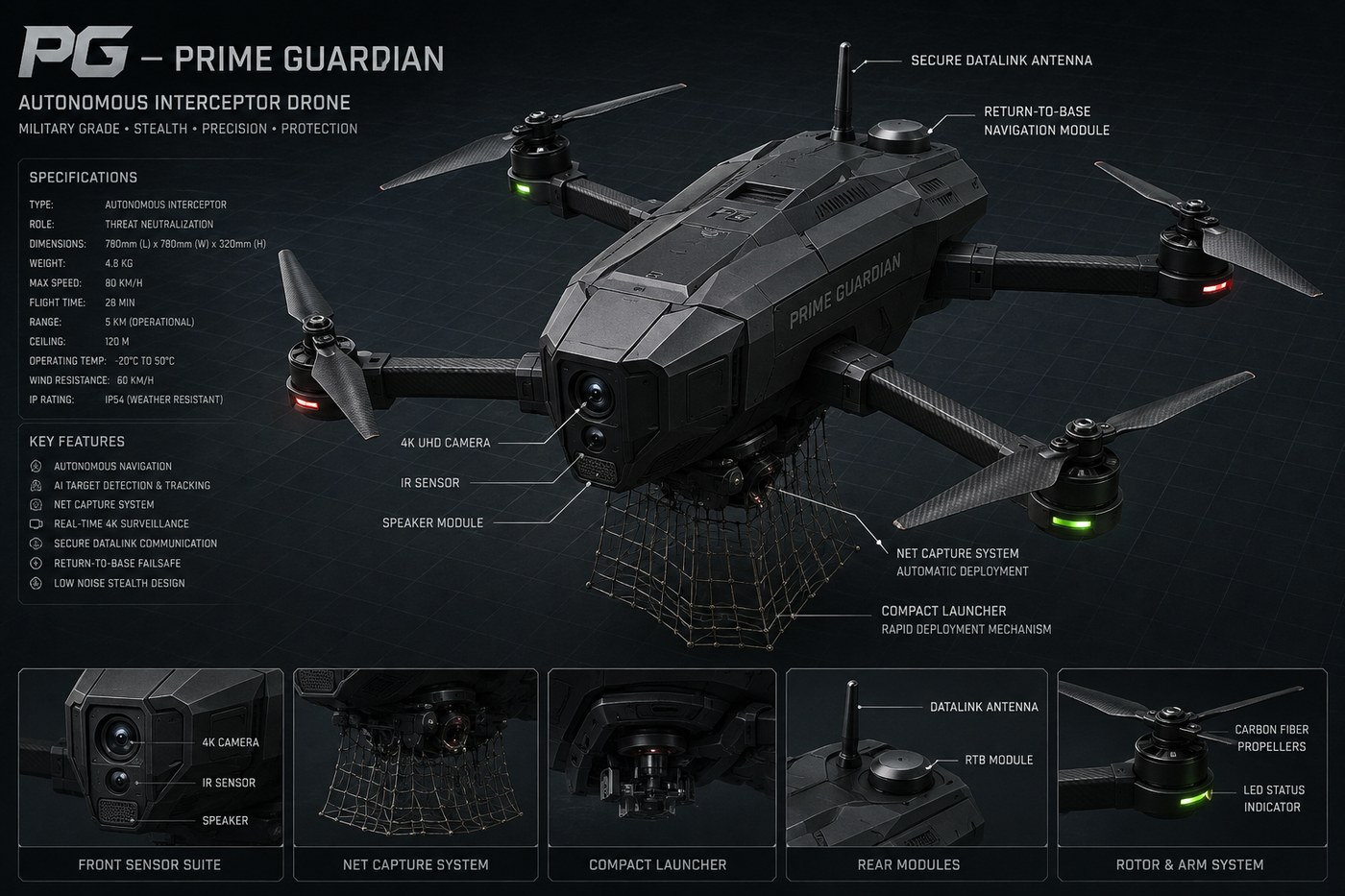
Numbers from the concept spec.
Performance targets set out in the current PG design documentation. These are design specifications, not field-tested results — each one requires independent validation before commercial use.
From awareness to controlled response.
Detection & tracking
Sensor fusion across radar, vision and GPS; concept tracking begins at roughly 750 m from the protected asset.
Interception workflows
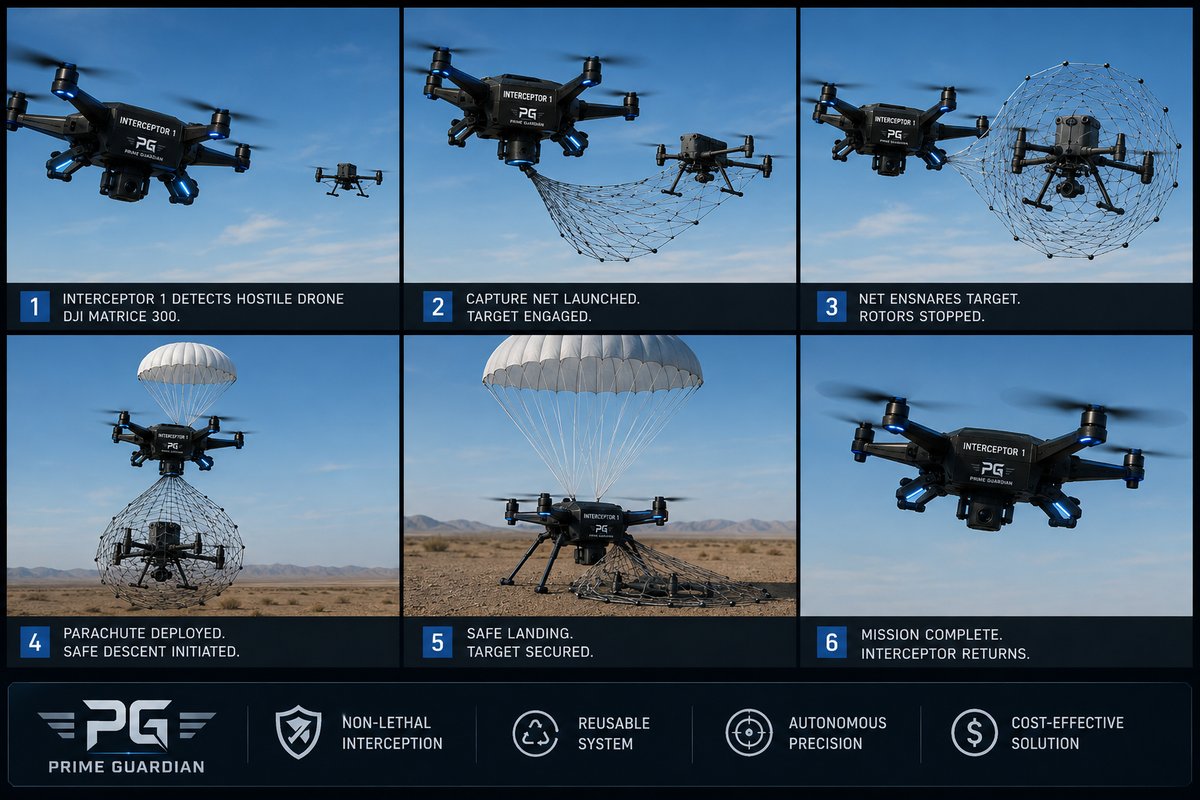
Staged response: alert at 500 m, net-capture preparation at 350 m, kinetic intercept only as a fallback at 150 m.
Multi-drone management
Guardian Unit Controller concept for coordinating fleets, telemetry and failover across multiple units.
Escort & protection
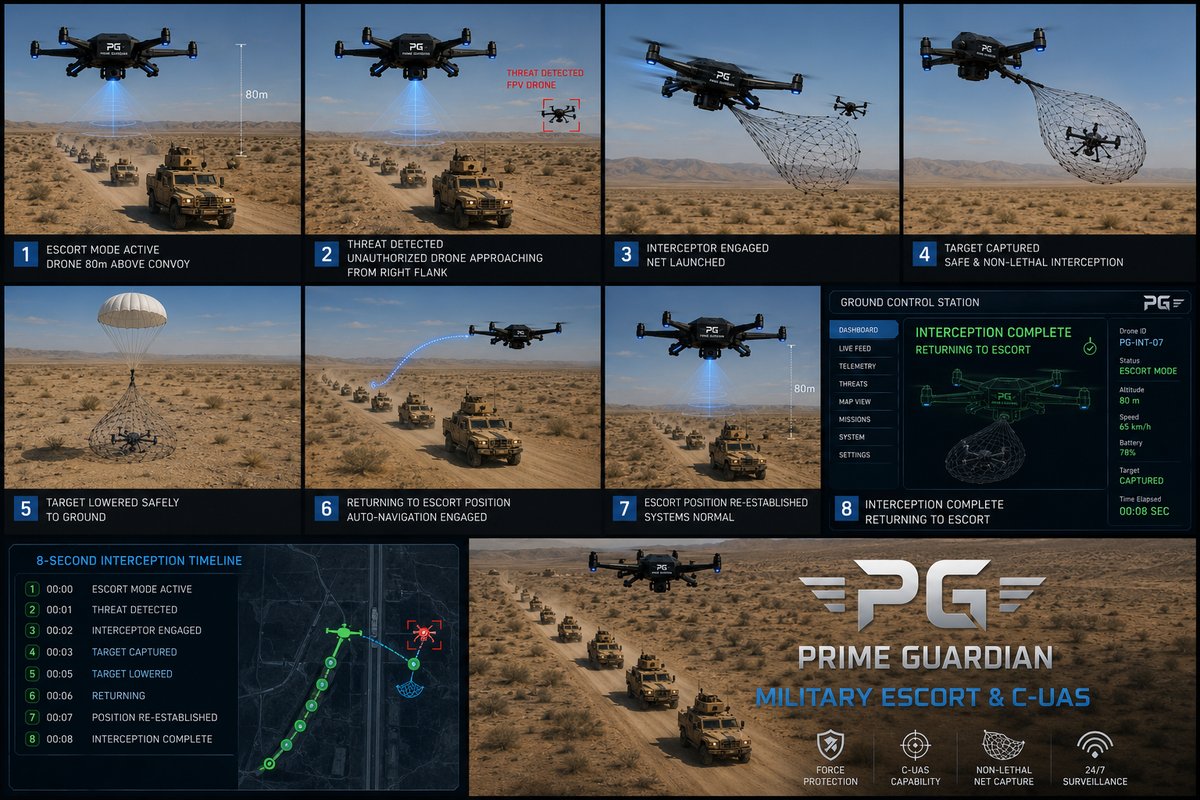
Escort Mode concept: define a protected asset, hold a protective ring around it, and follow while intercepting on threat detection.
Telemetry & auditability
Status updates to Ground Control at every stage, with mission reports generated after each run.
Licensing
Hardware-binding concepts are intended to protect authorized deployment.
Distance-based response staging.
The design document lays out escalation purely by measured distance to the protected asset, with Ground Control notified at every critical stage.
Built around reusable systems.
Base configuration described in the current specification sheet — pending prototype build and field validation.
Base platform
- 10–12″ carbon-fibre frame
- BrotherHobby 3115 900KV motors
- 80A ESC · 10×7×3 propellers
- 8S 13,500mAh Li-Ion
AI vision
- NVIDIA Jetson Orin NX 8GB
- Khadas OS08A10 camera
- YOLOv8n · 416×416 / 512×512
- 40–50 FPS (design target)
Net capture
- KARAKURT-K2-type launcher
- 3×3 m or 5×5 m net
- 15–35 m effective range
- USB Type-C charging
Flight control
- Pixhawk 6C · MAVLink v2.0
- STM32H743, 480MHz
- M8N / u-blox GPS
- SiK telemetry radio
What a mission could look like.
Concept visualizations from the PG design documentation — illustrative renders, not footage of a built or fielded system.

Built around reusability & software.
Prime Guardian is positioned as a software-centric defensive R&D platform. Performance and cost claims require independent validation before commercial use.
Jamming / fixed systems
May depend on spectrum, environment, site configuration and jurisdiction.
Reusable hardware concept
Potentially reusable after controlled missions; lifecycle cost depends on validation.
Software-led architecture
Detection, tracking, coordination, telemetry and controlled workflows.
960+ simulated tests
959+ passed in simulation (99.9% pass rate) per the current test log. Documented as "production-ready" at the software layer, with PX4/ArduPilot compatibility and a fully autonomous decision loop under Ground Control monitoring — hardware integration and field validation are the next gate.
Checklist & next steps.
Readiness checklist
✓ 10″ Cruiser-class frame & propulsion
✓ Pixhawk 6C + MAVLink
✓ Jetson Orin NX + YOLOv8n
✓ Net-capture system
✓ EO seeker + GPS + telemetry
Next steps
- Build prototype
- PG software integration
- YOLO training on local drone data
- Simulated testing
- Field testing in real environments
The wider ecosystem.
Have a technology problem?
For product, technology, business or general enquiries, contact Madflix Prime.
support@madflixprime.com